Most headlight upgrades start with the wrong question. Buyers ask which bulb is brightest, install it, and then wonder why the light looks scattered, why oncoming drivers flash them, or why the road ahead is a patchwork of bright and dark. The bulb matters, but the housing is what actually shapes the beam. It decides where the light lands, how clean the top edge of the beam is, and how much glare you throw at everyone else. Choosing between a projector and a reflector housing is the decision that determines whether an upgrade looks sharp and controlled or bright and sloppy.
Two ways to aim the same light
A reflector housing is a bowl lined with a mirror finish and divided into dozens of small angled facets. The bulb sits in the center, and each facet catches part of the light and bounces it forward in a slightly different direction. Because the light is spread across many surfaces, a reflector fills a wide area of road and is cheap to produce, which is why it has been the default on economy vehicles for decades. The trade-off is control: the top of the beam fades out rather than stopping cleanly, so some light always spills upward.
A projector housing works more like a small film projector. The bulb sits behind an elliptical reflector that gathers the light, a metal cutoff shield trims the top of the beam, and a convex lens at the front focuses everything into a tight, aimed pattern. That extra hardware produces a bright, even hot spot and a sharp horizontal line where the light stops. The same design that makes a projector precise also makes it more expensive and slightly fussier to install, since there are more parts packed into the assembly.
Beam pattern, cutoff, and glare
The single biggest practical difference is the cutoff line. A projector’s shield creates a defined edge that keeps light below the eye level of oncoming drivers while still lighting the road out ahead. A reflector’s beam has a softer top edge, so more light scatters upward and sideways. On an empty rural road that scatter can feel like extra visibility, but in traffic it reads as glare, and it is the reason a poorly matched reflector setup gets flashed so often.
High and low beam behavior differs too. A dual-beam projector uses a solenoid-operated shutter that drops the cutoff shield out of the way for high beam, so a single bulb covers both functions from one clean housing. A reflector typically needs either a dual-filament bulb or a second dedicated reflector to switch beams. Neither approach is wrong, but it changes which bulbs fit and how a replacement is wired.
Bulb compatibility is where upgrades go wrong
Dropping an LED or HID bulb into a reflector housing that was engineered for halogen is the most common upgrade mistake, and the charts below show why the numbers are misleading. A halogen filament is a small glowing wire in a specific spot, and the reflector’s facets are cut to aim light coming from exactly that point. An LED bulb puts its light-emitting chips in a different geometry, and an HID arc is larger and positioned differently. The reflector aims that mismatched source in the wrong directions, so a bulb that claims far more raw output can actually deliver a worse, glarier beam than the halogen it replaced.
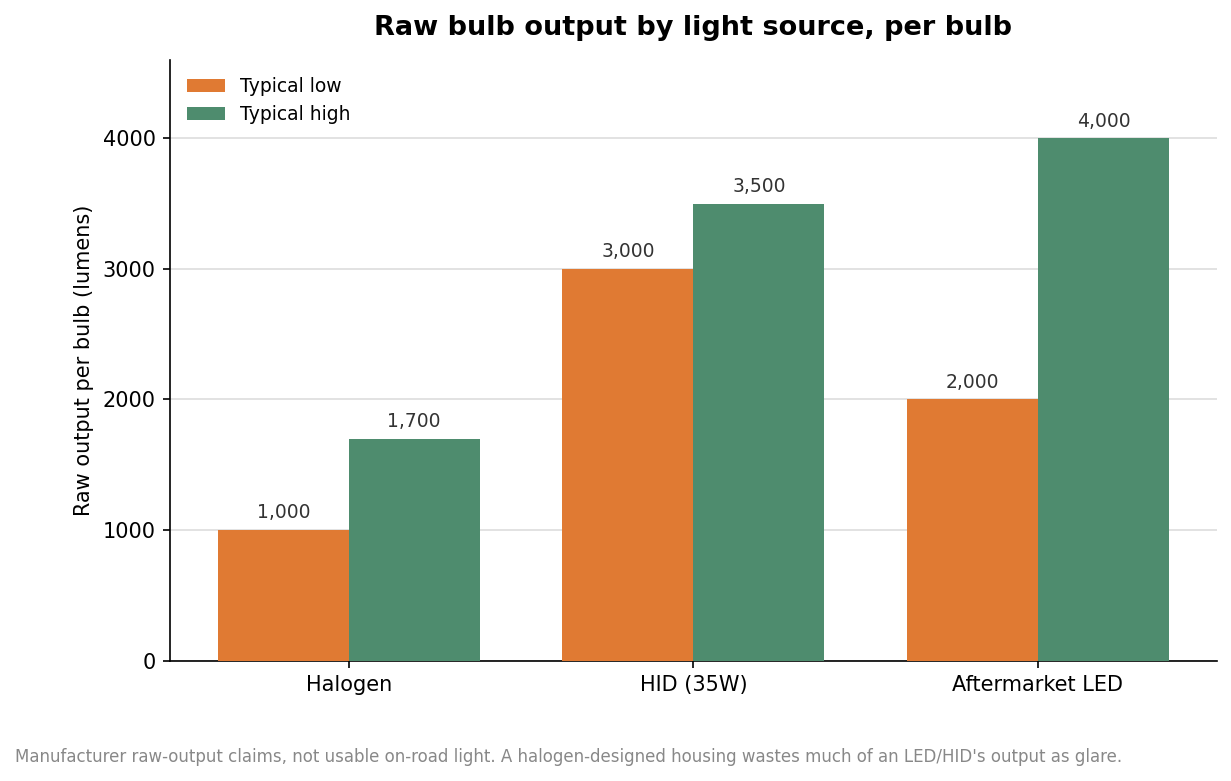
Projector housings tolerate a source swap somewhat better because the lens re-collects and re-focuses the light before it leaves the assembly, but only when the replacement bulb’s emitters sit close to where the original filament was. The reliable path is a housing built around its light source from the start: a factory or aftermarket bi-xenon or bi-LED projector is designed as one optical system, and it beats any mix-and-match bulb swap for beam quality. Treat raw lumen claims with suspicion and judge an upgrade by the shape of the beam on a wall, not the number on the box.
What it costs and what is street legal
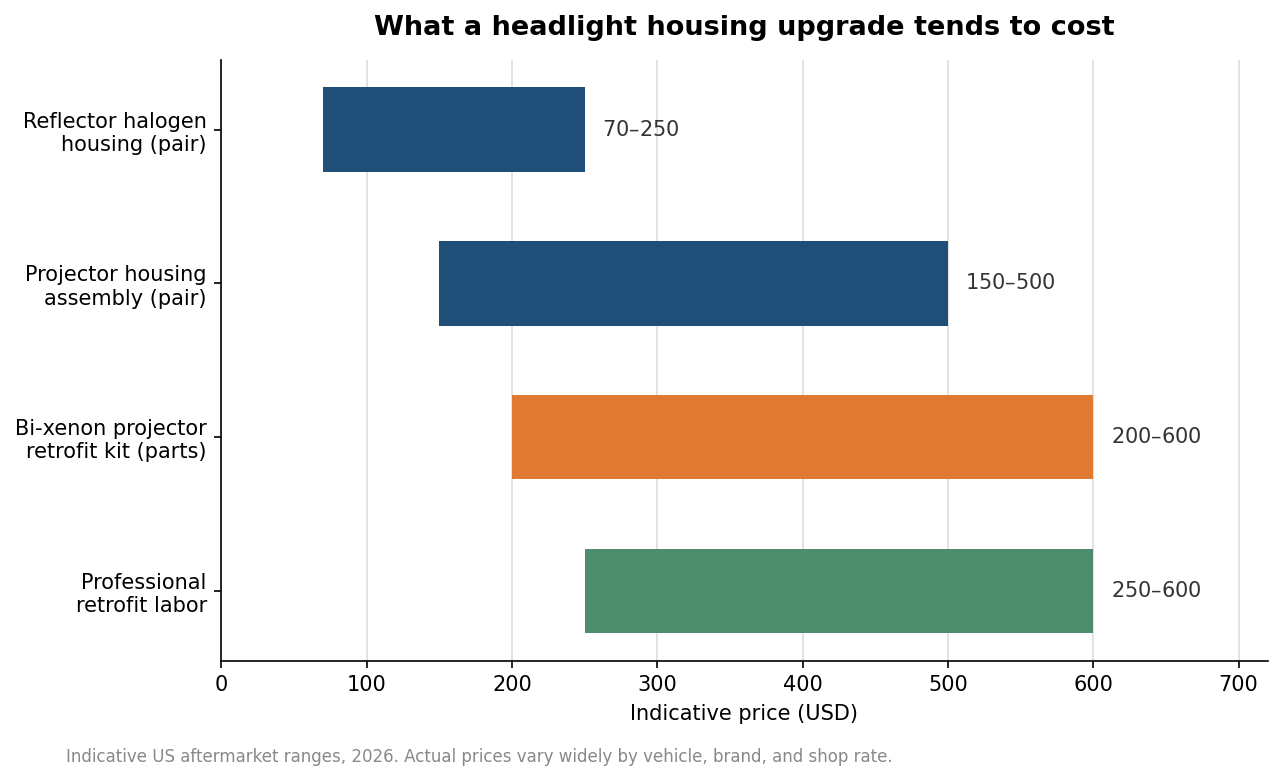
Budget depends far more on which path you take than on brand. A set of replacement reflector housings for a common vehicle tends to run in the low hundreds, a projector assembly runs higher, and a full bi-xenon retrofit — installing projectors inside existing housings — adds both a parts kit and several hours of skilled labor because the housings usually have to be opened and resealed. The ranges below are indicative aftermarket figures for 2026 and vary widely by vehicle and shop.
Legality is the part buyers skip. In the United States, headlamps must comply with Federal Motor Vehicle Safety Standard No. 108, and a legitimate replacement housing carries a DOT stamp and an SAE marking for each function. Swapping the light source to something the housing was never certified with — the classic LED-or-HID-in-a-halogen-reflector move — is frequently not compliant even when it is brighter, because the certified beam pattern no longer holds. If street use and inspections matter to you, choose a housing and source that were tested together rather than assembling your own combination.
Matching the housing to how you drive
For mostly rural, unlit driving, a strong projector low beam paired with a capable high beam gives you reach and a clean cutoff that does not blind the occasional oncoming car. For city and suburban driving, where glare complaints and frequent traffic dominate, the projector’s beam control is even more valuable, and there is little benefit to the wide upward scatter a mismatched reflector produces. If budget is tight and the vehicle already has decent reflector housings, the best-value move is often a quality halogen bulb aimed correctly rather than an LED that the housing cannot focus. Spend on the housing and the aim first; the light source is the last decision, not the first.