Every way of darkening a headlight trades some of the light the lamp was engineered to throw for a look. That trade is the whole decision, and the smart version of it is choosing the method and shade that get the style you want while giving up the least night visibility. Custom headlight tinting comes down to three practical questions: which application method, how dark, and which material and finish. This guide walks through each so you can spec a clean, reversible result rather than a hazy one you regret at the first dark on-ramp. It sticks to the how; the separate question of what is street-legal where you drive is its own topic and is covered in our compliance guide.
Three ways to tint, and why film usually wins
There are really three methods. Spray tint is an aerosol tint sprayed onto the lens. It is cheap up front and can look even when done expertly, but it is hard to undo: reversing it usually means sanding or chemical stripping, which risks the clarity of the factory lens underneath. It is also prone to overspray, dust in the finish, and uneven curing, so consistency depends heavily on conditions and skill.
Film, applied as a pre-cut or bulk sheet, is the route most shops steer toward, and it splits into vinyl and TPU. Film is manufactured under controlled conditions, so opacity is engineered and uniform rather than dependent on a spray pass. It peels away cleanly without residue and without harming the lens, which makes the whole modification reversible, and it doubles as a sacrificial layer that takes road rash and stone chips instead of the lens. The upfront price is a little higher than a can of spray, but because it protects the lens and can simply be replaced when it ages, it tends to be the more cost-efficient choice over the life of the car.
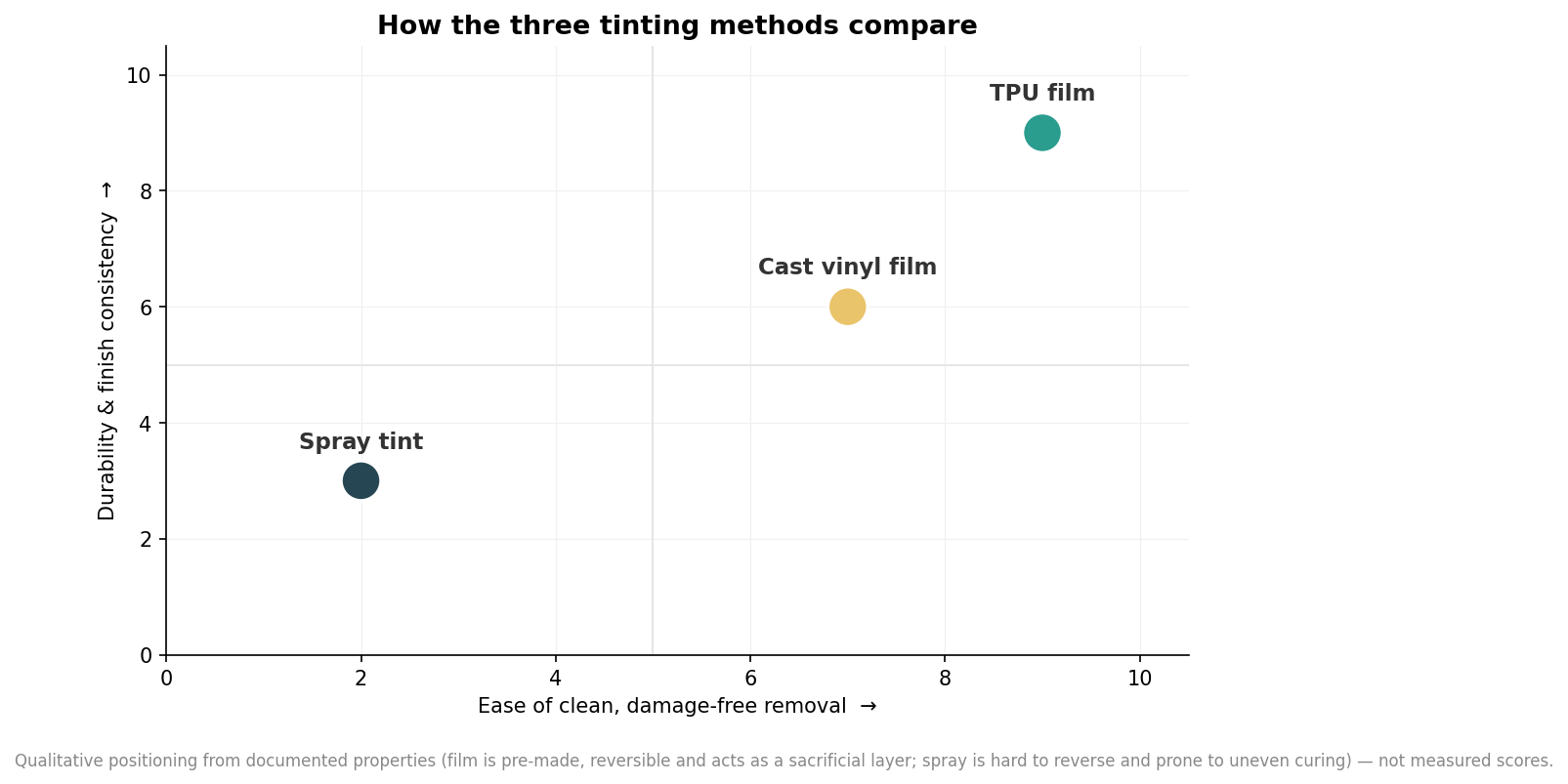
The short version: spray is the cheapest to start and the most painful to reverse, vinyl film is a solid reversible middle, and TPU film sits at the top for durability and clean removal. Unless budget is the only constraint, film is the safer bet for a factory lens you may want clear again someday.
Choosing a shade: darkness versus the light you need
Shade is where enthusiasm outruns physics. Tint is usually sold as light smoke, medium smoke, dark smoke, and a blackout or limo level, and it is easiest to reason about on the standard tint scale of visible light transmission, or VLT. A higher VLT number means more light passes through: a light smoke around 50% VLT lets roughly half the light through, a medium around 35% clearly darkens the lens, a dark smoke near 20% is heavily shaded, and a blackout near 5% is almost opaque.
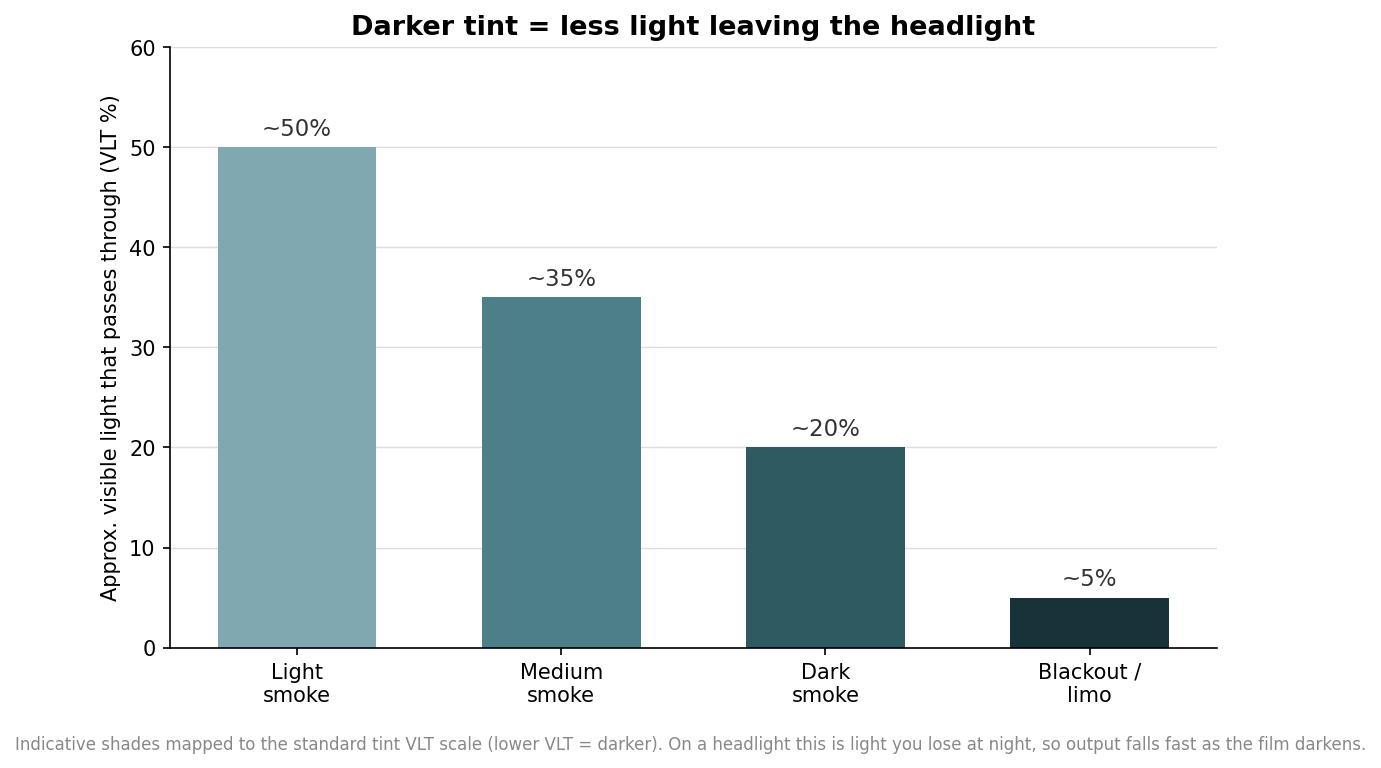
On a window, VLT is about privacy; on a headlight, it is the light you are throwing away. A headlight is a safety device with a designed output, and film sits directly in that beam, so a 20% dark smoke is not a modest styling tweak, it is cutting your usable light by roughly four fifths. The honest recommendation is to pick the lightest shade that delivers the look you are after. A light smoke gives most of the aggressive, blacked-out appearance in daylight and when the lamp is off, while surrendering far less output after dark, and it keeps you closer to whatever local rules require. Reserve the truly dark shades for show cars and off-road or trailer-queen builds that are not relying on those lamps to drive at night.
Material: TPU versus vinyl, and why edges crack
Among films, the material matters because headlight lenses are rarely flat. Many are compound-curved, bulging in two directions at once, and that is exactly where cheaper films fail. Cast vinyl conforms well to gentle curves and is the established, affordable option, but on a sharply curved lens it can lift and crack at the edges over time, especially if it was stretched hard or the corners were not sealed down properly.
TPU, the same flexible material used in paint protection film, is built to stretch over rounded shapes and sit tight to the contour without wrinkling, so it handles aggressive lens curvature better and resists edge failure. It carries a higher material cost, which is the trade-off. If the lens is close to flat, vinyl is often all it needs; if it is a modern, heavily sculpted headlight, TPU earns its premium by staying put. Either way, the edges are the tell: a good install wraps or tucks them so nothing catches air, water, or a pressure washer.
Finish, color, and specifying a clean result
Beyond darkness, film comes in more than just black. Smoke is the standard gray-to-black tone, a yellow film mimics a classic fog-lamp or European look, and color-shift or chameleon films flip hue with the viewing angle for a show effect. Finish is usually glossy to match a headlight’s natural sheen, though matte is available for a stealthier appearance; a gloss finish generally reads as more factory-like on a lens. Whatever the color, remember the light passing through it takes on that cast, so a heavy yellow or dark smoke changes both the look and the character of the beam.
To spec a clean job, start from how the car is used and let that cap the darkness: a daily driver wants a light shade that keeps the road lit, while a display build can go darker. Match the material to the lens shape, TPU for strongly curved lenses, vinyl for flatter ones, and choose a finish that suits the rest of the car. Insist on precut patterns or careful trimming and fully sealed edges, since sloppy edges are what turn a reversible upgrade into peeling, cracking, and trapped moisture. And confirm the local rules before committing to a shade. Get those choices right and headlight tint is a genuinely reversible piece of customization; get the shade or the edges wrong and it is a safety and clarity problem waiting to happen.